Why AI needs a better approach to partner reward metrics
October 14, 2026

.png)
October 14, 2026
Despite profitability being a strategic focus for professional firms for over 20 years, our research indicates that profit-based measures trail revenue and origination metrics when it comes to assessing partner performance. Similarly, strategic priorities such as client loyalty, collaboration and innovation do not figure prominently in how partner performance gets measured. On paper, most firms describe a balanced scorecard linked to strategy. In practice, production wins.
So what does this mean for AI experimentation and adoption?
In our 2026 Equity Partner Contribution and Compensation Survey, we asked firms which three measures have the biggest impact on the reward of a client-facing partner. Figure 1, a tree map, shows the relative weight of these measures: managed and supervised revenue is the clear number one, followed by originations and financial contribution. There was no mention of AI.
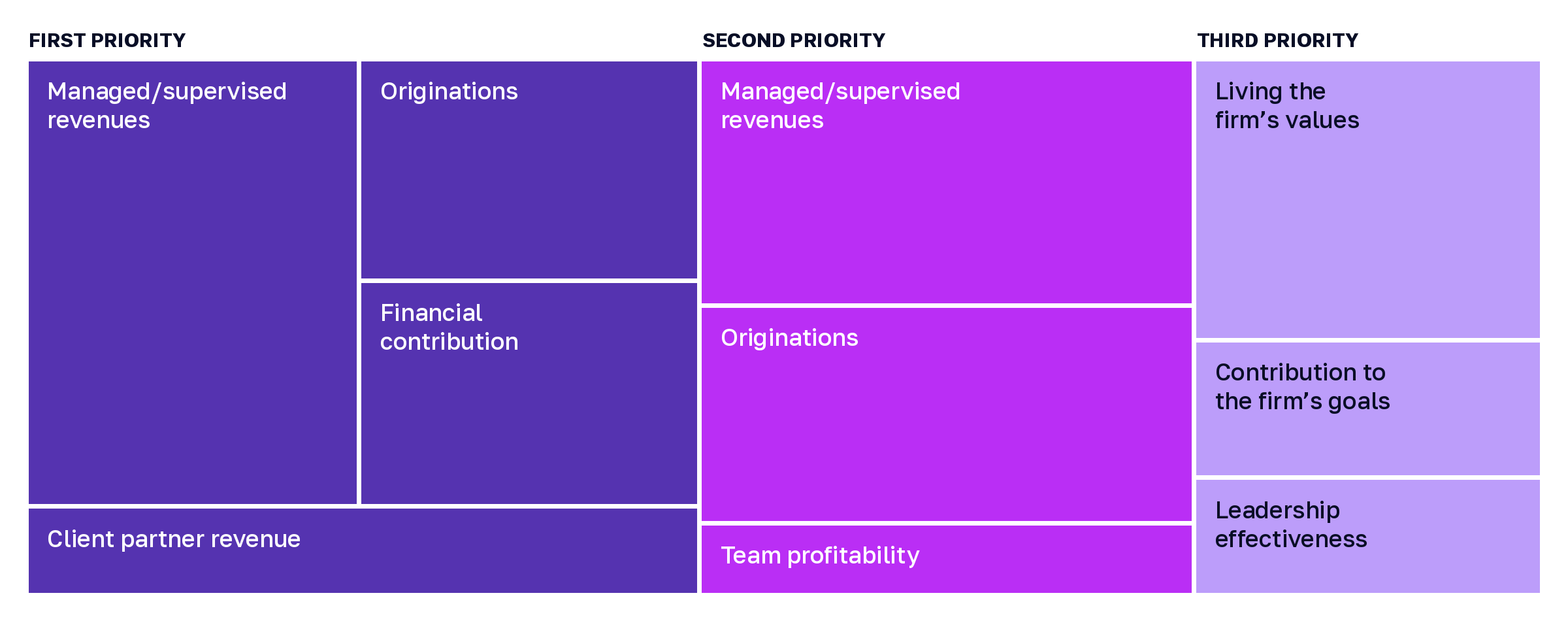
Elsewhere in the survey, we asked respondents whether partner reward incentivises AI experimentation. Just 21% of firm leaders agree that their partner compensation system is designed to encourage equity partners to experiment with embedding AI in how their teams deliver services; 36% are neutral, and 43% disagree.
Some will argue that equity partners should stay focused on revenue generation. We argue that targeted experimentation, usually in collaboration with technology experts and team members, should be incentivised where the outcome of that work is revenue protection or profit maximisation.
Equity partners possess synergistic judgement, built on deep expertise and years of experience. Excluding this group from targeted experimentation seems unwise, and Norm Law’s hiring of veteran equity partners from established firms may be early evidence of this.
As in every aspect of partner reward, balance and judgement are required. But given how much money is being invested in AI, shouldn’t reward systems reflect that too?
This gap between firm strategy and partner reward is not new. It has run through the past decade of our research into partner reward, and in our 2019 survey we noted the same absence: collaboration and innovation were missing from the measures firms used to assess partner performance. So why does this gap persist?
Is it inertia? RemComs get handed the same financial contribution data year after year, and many firms roll from one cycle to the next without questioning their inputs. A reward-round debrief that reviews the data itself, not just the outcome, would help.
Is it data ownership? Input data usually sits with the CFO and comes straight out of the practice management system. It is destined to stay narrow unless a deliberate effort is made to broaden it. Expertise beyond the CFO is needed: the RemCom chair, the CPO or Head of Reward, and external members can all help broaden the inputs. Our research shows that only 30% of firms have an independent voice on their RemCom.
Or do we simply measure what’s easy to measure? Managed revenue is well understood and easily measured. Originations are more contentious to calculate, but the methods are usually well understood. Profit is harder to pin down: gross or net, client, matter or group. Look at Figure 1 again: the measures seem to run in order of how easy they are to measure; not how much they matter.
AI experimentation faces real hurdles before it can become part of that reward conversation. First, its payoff is further away and less certain: a partner who redesigns a workflow around AI tools may not see the benefit for a year or two. Second, and more awkwardly, AI experimentation can look a lot like underperformance in the short run: hours and billables fall, and write-offs rise, while the team learns.
At employee level, we’re already seeing firms use a mix of recognition and reward to encourage AI experimentation: letting staff claim innovation hours for AI experimentation and learning, offering reward tokens and bonus pools, and running firm-wide recognition and awards programmes.
Three ways to incentivise AI (and other strategic ambitions)
Firms themselves already point to where this goes next. When we asked respondents about their top priorities for evolving partner contribution and reward over the next 12 to 24 months, aligning reward to strategy came out well ahead of everything else. Closing that gap requires firms to pull a few specific recognition and reward levers.
Recognition: celebrating experimentation and success
One of the most effective ways to motivate high-achieving professionals is public recognition. It’s also cheap and immediate. In The Partner Remuneration Handbook, we discuss how recognition remains an underused tool for motivating partners. Firm recognition programmes often celebrate employee achievements, not partner achievements, which is a significant oversight: high-achieving professionals don’t suddenly stop being motivated by recognition once they make partner. Plenty of firms already run award programmes for AI initiatives and impact at employee level. Why not make these team-based awards that include both partners and employees? Recognition is a critical lever for supporting AI transformation, and it requires no redesign of your reward system.
Mitigation: removing disincentives
Before introducing positive reward incentives, consider how your current reward system discourages the right behaviours, then mitigate. Utilisation is one example: it discourages AI experimentation, just as it discourages mentoring, business development and pro bono work. The simple fix is a specific AI/innovation hourly allocation, kept out of utilisation calculations. Firms are already doing this for employees.
How far should this go, given the growing non-billable load already sitting on partners? We know partners are increasingly stretched across non-billable work, so what should count toward contribution, and what must give, as leaders try to balance short-term profit against long-term gain? Our preferred approach is to use partner-specific objectives, tied to targeted, strengths-based contribution, and to calibrate these alongside traditional financial measures at assessment time.
Reward incentives: innovation as part of a balanced scorecard
The strongest fix is structural. Many firms already run some version of the Kaplan & Norton Balanced Scorecard, spanning financial contribution, client development, human capital and culture. Give AI-enabled practice change a real presence in that scorecard, with its own weighting and supporting evidence, and use it to influence profit allocation, bonuses and longer-term incentives.
At assessment time, the question isn’t whether a partner or their team experimented with AI, but what they achieved: what impact did it have on protecting revenue or maximising profit, and what impact did it have for clients, measured through qualitative and quantitative client feedback? Impact is the key word if innovation is going to be taken seriously inside a scorecard.
Once again, a strengths-based approach to applying this framework matters: it shouldn’t be one-size-fits-all, regardless of a partner’s practice, clients or skillset.
It’s clear that many firms struggle to move beyond traditional financial metrics when it comes to assessing partner performance. Our challenge is to recognise and reward those partners who will both keep growing revenue and profit, while supporting the firm’s strategic ambitions as co-entrepreneurs. AI is the latest example of a strategic imperative that needs to be aligned with the reward system. Failure to do this may become a significant handbrake on change.
Sources
Performance Leader and MHPR Advisors, Equity Partner Reward in the Age of AI Disruption: Key Findings from the 2026 Equity Partner Contribution and Compensation Survey
Performance Leader and MHPR Advisors, The Partner Remuneration Handbook
Learn how Performance Leader helps leading firms to manage equity partner and employee contribution and reward