Reflecting on a decade of research into partner reward. What's next?
In preparation for our 2026 survey, we take a look back at key themes to emerge from our research.
April 11, 2026

In preparation for our 2026 survey, we take a look back at key themes to emerge from our research.
April 11, 2026
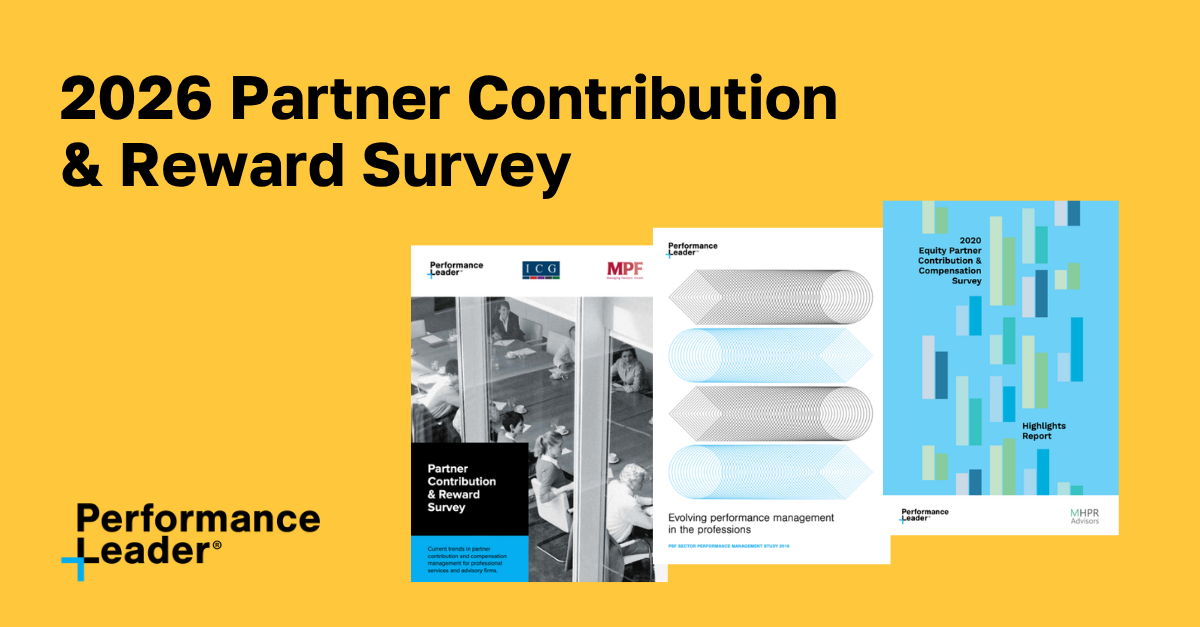
For the past ten years, Performance Leader and MHPR Advisors have been researching equity partner contribution and reward practices in professional firms. With our 2026 Partner Contribution & Compensation Survey launching next week, here are some of our reflections on that research, and some inspiration to join our 2026 survey.
Our surveys across 2015, 2017 and 2020 — drawing on responses from firm leaders, RemCom members, and senior HR professionals, primarily acrossAustralia, the UK and Continental Europe — have tracked a clear and consistent structural shift. Pure lockstep systems, in which partner reward advances based on time served, are in decline.
Replacing pure locksteps are managed locksteps and meritocratic reward models, both of which require greater discernment when determining partner reward.The roles of leader and RemCom member are elevated. Processes are redesigned and technology is applied.
Here is the finding that has been most consistent across every edition of our research. Roughly three-quarters of the contribution measures that firms use to drive partner pay decisions relate to production and origination: matter billings, supervised fees, individual profit, team profit, and sales.
Everything else including notable strategic challenges like innovation, collaboration, CX and technological transformation, barely registers. Closing this gap between strategy and execution is a pressing challenge, and we’re interested to see the state of play in 2026.
One of the most striking longitudinal findings from our research is the upward drift in the top-to-bottom equity spread: the ratio between the highest and lowest paid equity partners. Between our 2017 and 2020 surveys, the most common spread shifted from the 2:1–3:1 range to 3:1–5:1. A growing number of firms reported spreads of 5:1 or higher, with some pushing well beyond that.
The primary purpose of this widening gap is to increase reward for top performers. Competition for high performing partners has accelerated in recent years with the global expansion of US firms. In 2026, we fully expect this gap to have widened further. What will be the most common ratio across our respondent group? We could guess – but let’s just find out.
There are risks that come with this shift. Stretch the spread too far and firms begin to erode the collaborative culture and work-sharing behaviour that the reward model is supposed to encourage. Every partnership needs to have a mature conversation about its spread – and what needs to be done to balance competitiveness with cohesion.
Across every edition of our research, the governance of reward decisions has emerged as a stubborn and recurring area of weakness. In too many firms, the RemCom is not functioning as a genuine decision-making body — it is ratifying conclusions already reached informally, providing a procedural veneer. Transparent governance is not a nice-to-have; it is a precondition for the partner confidence that sustains a high-performing partnership.
Across our survey history, addressing poor performance has consistently ranked as the least well-fulfilled objective of the formal partner review process — and by a significant margin. The causes are well understood: the structural awkwardness of a peer-review culture, insufficient training for partner-leaders in having difficult conversations, and review processes that are retrospective. The remedy requires more frequent check-ins and governance structures that give partner-leaders both the tools and the mandate to intervene.
Our research has also tracked firms' use of technology to support partner performance and reward processes. Technology use is trending upward.Originally it was larger firms utilising technology for performance processes, but this has broadened to firms of all sizes. Analytics that support decision making are underutilised. When it comes to reward, many firms continue to rely on spreadsheets and document bundles to feed the RemCom.
A great deal has changed since our last survey. How to adjust the operating model for AI is the most pressing challenge on firms’ agenda. For the first time, our survey will ask how firms are designing reward models that absorb the financial risk of AI experimentation. We are also exploring how firms are integrating AI tools into reward determination itself.
If you are a managing partner, board chair, CPO or RemCom member, your perspective is essential to producing this research. Participants receive the full results report and invitations to our online and in person briefings. The survey takes 15–20 minutes to complete.
The profession is at an inflection point. Help us understand what that means for equity partner contribution and reward. Our survey will be released on Monday 20 April.
Learn how Performance Leader helps leading firms to manage equity partner and employee contribution and reward