Inside the RemCom: Webinar highlights and takeaways
November 16, 2026

November 16, 2026
81% of firms now run merit-based partner reward, and 37% have a top-to-bottom equity pay ratio of 5:1 or more, according to our 2026 Equity Partner Contribution and Compensation Survey. When spreads are that wide, every RemCom decision carries more weight and is more likely to be questioned.
The same survey found that only 21% of partner leaders say their firm supports partners to invest in developing AI in their services, and 43% say their firm or its system discourages it.
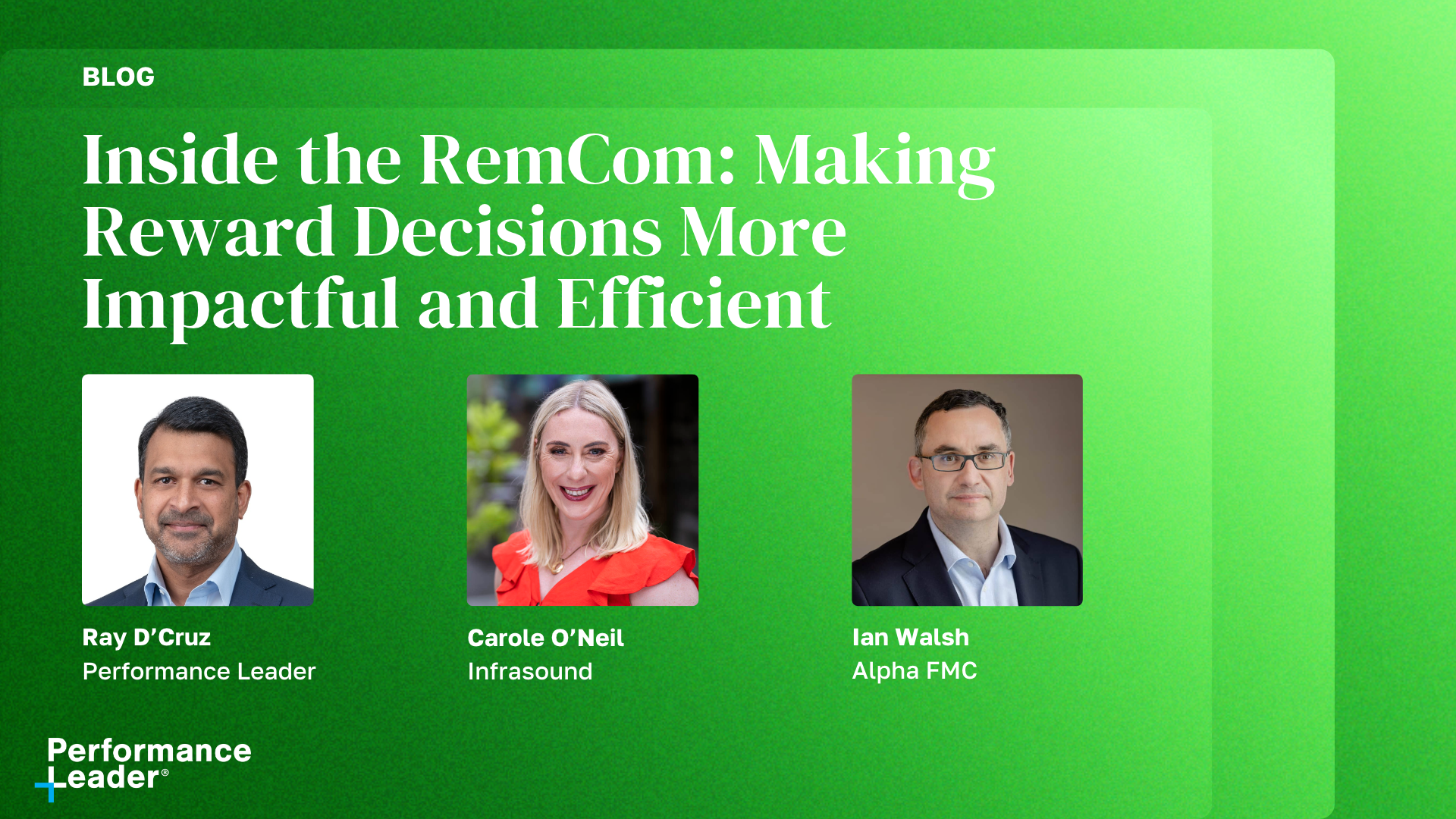
During our webinar on 5 November 2026, Ray D'Cruz of Performance Leader asked two people who have spent years in the RemCom room how the best committees make these calls. This is their conversation, lightly edited.
Carole O'Neil spent many years as a senior HR leader in professional firms, and most recently was Managing Partner of Cundall, the global engineering firm, where she oversaw performance and reward. Carole now runs her own coaching practice, Infrasound, helping ambitious women choose their next chapter deliberately and lead on their own terms.
Ian Walsh is Chief Operating Officer and a Board member at Alpha FMC, a global boutique consultancy serving the financial services sector and owned by Bridgepoint. Before Alpha, Ian spent more than 25 years at the Boston Consulting Group, including as a member of BCG's Global Partner Performance Committee.
In this piece
• BCG assessed 2,200 partners on two things: commercial performance and feedback from at least 15 peers and 15 non-peers.
• Cundall turned narrative feedback into scores centrally, because individual raters were inconsistent.
• Who gets nominated for feedback reveals how connected a partnership really is.
• BCG called them toxic rainmakers: coached first, allowed a one-off bad year, blocked from promotion if the pattern persisted, and
in a handful of cases exited.
• "Synthetic" credits rewarded long-term investment, but commercial credits still carried more weight.
• Reward the year, promote the trajectory.
• BCG allocated 150% of every project's revenue, and it made year-end conversations easier.
• BCG was transparent on inputs but, for years, a black box on process.
• Out of 60 partners, Carole could count on one hand those who asked for detailed feedback in most years.
• Weighting double-hatted partners was "a little bit smoke and mirrors" at Cundall. BCG used explicit time splits.
• The numbers and the stories both matter: argue for and against, then vote.
Ray: Ian, you've seen this from two vantage points: BCG, and now Alpha, a PE-backed firm. Tell us about the performance and reward processes you've experienced.
Ian: I spent over 25 years at BCG as a financial services partner and senior partner. I sat for about 10 years on our UK RemCom, which covered about 100 partners, and then three years on BCG's global RemCom, which touched 2,200 partners.
The process was annual. It went through the local RemCom, then a regional calibration, then the global RemCom, all in the first quarter, based on the prior year's performance.
We assessed partners on two criteria: commercial performance and feedback. Commercial performance drove the P&L. Feedback was about managing and building the balance sheet, the balance sheet being our people. We were looking for partners who struck the right balance between the two.
Commercial performance was measured mainly through a currency of revenue credits. For senior partners, we also looked at their overall revenue footprint, and at their sharing and sponsorship behaviour: their ability to bring through junior partners and make them successful. For feedback, we ran a comprehensive, anonymous process every year, and each partner needed input from at least 15 peers and at least 15 non-peers.
The global RemCom then made two decisions on each partner. One was slotting: whether they moved up or down the partner levels, which drove nominal salary. The other was the discretionary award. The compensation model was roughly 50% arithmetic, driven by revenue, and 50% discretionary award.
Carole: There are some parallels, and quite a number of differences. Our partnership was much smaller: around 60 partners when I left in June, but spread across 29 offices in the UK, Europe, Asia Pacific and Australia. When I joined almost 20 years earlier, we were around 15 to 20 partners in five UK offices.
By the time I left, our RemCom was four partners elected from within the partner group, usually including the chair of partners, plus me as managing partner, ex officio. We ran an annual cycle but split the decisions: notional salary and equity points at one point in the year, profit share at another. Towards the end, the RemCom was meeting much more often to work on improving the process itself.
Contribution was the language we used, in its broadest sense. We had everything you'd expect around commercial performance, client relationships and work-winning, but also less tangible things: culture, values, ethos and leadership. Some of that was measured by the RemCom, and some through feedback from the wider partner group, in a less scientific way than Ian described.
One growing challenge was that more of our partners weren't directly client-facing. I was managing partner, but I'd come through an HR route, so I had never had a revenue-generating role. We had other senior equity partners in a similar mould. How to benchmark them against partners measured on more tangible criteria was quite a puzzle.
Ray: How do you actually bring quantitative and qualitative input together and hold both at once?
Carole: Engineers very much like quantitative data and are more comfortable with it than with the less tangible stuff. So the first thing our RemCom did with qualitative data, such as partner feedback and employee engagement surveys, was try to put a number on it.
We experimented with scales of one to five and one to 10, and with whether people scored directly or we translated their narrative comments into a number. We settled on the latter: people commented in a narrative way, and we converted that into a rating. That gave us some consistency, because Ray's idea of a four out of 10 might be very different to Ian's. When we did ask people to rate, we analysed it person by person, and it became very clear who the harsh markers were compared with the generous ones.
The feedback also gave us unexpected insights. When we asked, "Who should we invite feedback from about this partner?", the same names came up over and over again, right across the partner group. Some people were never being approached at all. Working out why told us a lot about connectivity within the partner group, and how far partners were collaborating with each other outside of just delivering the work.
Ray: Ian, 15 peers and 15 non-peers sounds eye-watering. How did you bring all that together?
Ian: BCG's global RemCom was very data-led, but not only data-led. We could see revenue credits by partner, by client and over time, FX-adjusted and calibrated, so we could tell whether any partner was in the top 10% or the bottom 20%. We could also see how each partner was scored by peers and non-peers on various dimensions, and how that compared with the partnership over time.
So on a partner's front-page scorecard, we could do pattern recognition very quickly. We could see, for example, a partner generating ever-increasing revenue from an ever more concentrated client set, but struggling to manage the team sustainably. A lot of it was visual.
The risk was that we almost became human algorithms, dealing with hundreds and even thousands of partners: do the pattern recognition, do the calibration, give the score. So much so that you'd almost ask, why can't AI do it for us? That's where the qualitative pieces come in.
Part of the answer was the process. Local RemComs, where discussion was partly data-led and partly feedback-led, fed recommendations into a regional calibration and then the global RemCom. The global RemCom included all our global practice area leaders, our regional chairs and a few elected representatives, so someone in the room always knew the individual.
The global RemCom was a seven or eight-day meeting of 12-hour days. We worked in batches by partner level, laddered partners on the incoming recommendations, and zeroed in on the shoulder of the curve. Is this person in the top rating or the second? Have we found the shoulder? Calibrating in batches helped tease out the qualitative from the quantitative.
Ray: An audience question: how do you deal with a toxic high performer? Strong quantitative measures, but the qualitative suggests they're difficult to work with and culturally damaging.
Ian: We could all be puritans and say you exit anyone with questionable values straight away. It's never that easy, especially with commercially strong individuals. We in BCG had some of these, as I'm sure every organisation has. We called them toxic rainmakers.
First, we tried to help them. We recognised their commercial strength and were clear about the challenge: you're burning through the balance sheet to generate this value. We'd often offer coaching. We were a little generous if someone appeared toxic for one year in the data, because some of our feedback mechanisms were vulnerable to outliers.
But a multi-year pattern of strong revenue and very negative feedback needed addressing. It would block upslotting, and it was a red line for promotion to senior partner. In extreme cases it was a reason to exit. We had probably a handful in my time on the global RemCom where, even though they were very strong commercially, we felt the juice was not worth the squeeze, and we exited them, after trying to help them first.
Carole: A lot of that resonates. I'd add a more HR answer. We worked hard through our RemCom to protect the almost family-feel culture we had built as a smaller partnership as we grew and became more corporate. So we looked at these issues through a values lens: which of our stated values is this behaviour not aligned with, and how seriously are we taking it?
We weighted the different areas of contribution in our RemCom criteria. As we grew, the weighting on the harder commercial metrics increased, and we were probably in danger of losing sight of some of those cultural elements.
The other lever was the partner performance review, which we kept completely and deliberately separate from the RemCom. Behavioural change was dealt with there, outside the RemCom cycle. We also upskilled the leadership team in delivering difficult feedback. Where we'd seen toxicity escalate, it was because it wasn't nipped in the bud: people didn'thave the feedback skills to address it.
Ray: There's a real tension between short-term commercial results and investments, like embedding AI in service delivery, that might not pay off for two or three years. How have you seen that resolved? And how did you weight commercial and other contributions?
Ian: In BCG, both commercial performance and feedback were quantitative and qualitative. Revenue credits came with qualitative input from practice leaders on client-building, and feedback scores came with comments. So the balance we struck was between commercial and firm-building objectives, not between numbersand narrative.
Notionally, the split was 50:50. In reality, as Carole said, these conversations tilt towards commercial performance. We calibrated people commercially first, then tilted them up or down based on feedback.
Revenue credits were also an elastic currency. Most came from client billings, but if you were breaking into a target client that would take two or three years, you'd get synthetic investment credits. Partners in major leadership roles got management credits. That let us incentivise strategic behaviour in a common currency. The AI explosion happened after I left BCG, but I imagine many AI initiatives are now rewarded with those synthetic credits.
There were recurring debates, though. Some partners built up large amounts of management, investment or social impact credits, and eventually the conversation became: you can't live in this synthetic world. We need to see a reasonable dose of commercial contribution from you. So commercial credits always got special attention.
Ray: Carole, innovation is clearly important in an engineering firm. How did you balance it against short-term results?
Carole: Business improvement, innovation and R&D was a specific RemCom criterion. Much of that work happened on revenue-generating projects, so partners were almost getting double credit for it.
We also weighted contribution differently for notional salary and profit share than for moving up the equity. Equity advancement was about working on the business, not just in it. To reach the upper ranks, partners had to go beyond delivery, revenue and client management and actually improve the business. Our philosophy was that we were building a business for the next generation: build it, grow it and hand it on. There was never an exit on the horizon.
Ian: That distinction between in-year reward and multi-year progression was at the forefront at BCG too. The discretionary award reflected in-year performance, commercial and feedback. You had good years and bad years.
Slotting reflected a multi-year trajectory, with a test at each level. Level two to three: are you self-sustaining, standing on your own two feet? Level three to four: have you put other partnersinto business? Level four to five: have you built a franchise within BCG?
Carole: And equity points can go down as well as up. We were only really getting to grips with that towards the end of my time at Cundall. In a smaller partnership, the only way was up, and removing equity points was almost unprecedented. As we grew and became more scientific about measuring performance, we increasingly had tough conversations about going down the snakes as well as up the ladders.
Ray: Another audience question: how did you distinguish between originating revenue and developing existing relationships?
Carole: They were distinct criteria in our RemCom process. Business development and work-winning was one, and work delivery another, measured first on profitability. But on very big, complex, technical engineering projects, profitability isn't entirely within the gift of the partner running the job. So it was a little bit of art as well as a lot of science.
Ian: When you get a compensation system designed by management consultants, you get complexity built into it. At BCG, sold projects generate revenue credits, allocated at year end on a standard formula across the original relationship, the sales effort and delivery.
The trick is that BCG uses an inflated currency. On a million-dollar project, a partner can allocate 20% for relationship, 30% for sales and 100% for delivery: 150% in total. Everybody knows it's inflated, but somehow, emotionally and behaviourally, it made the year-end allocation conversations far easier.
It also meant you couldn't reach your targets on relationships alone, as that's a lot of 20%'s, so all partners were encouraged into selling and delivery. For more senior partners, we focused more on the total footprint of the accounts they led, because those accounts fed the more junior partners.
Ray: When pay spreads widen, partners want to know why they've landed where they have, particularly near the bottom. Ian, how transparent should firms be about reward outcomes?
Ian: I don't have a perfect answer, but I can tell you our journey. We were very transparent on inputs. Every partner could see their revenue credit and feedback data in detail, and what percentile they were in across the partnership on every dimension.
The process itself was, for many years, a bit of a black box. Partners weren't sighted on the local, regional and global discussions. At the end they got a two-pager with their feedback, slotting and discretionary award, often delivered by people who weren't in the room at the global RemCom. We'd have very rich discussions about individuals, but we still had to conquer the last mile: transmitting them back out.
So we standardised and sharpened how the two-pagers were written, so they weren't just based on the hand that wrote them, and trained the career advisors who delivered them. We also gave each local partner group an anonymised walkthrough of the global data, which eased the pressure. You may think you've done very well, but here's the global spread, and we had some superstars lifting the average. It's still a work in progress, as it is for any firm.
Ray: Carole,what do you think is the right approach to communicating results?
Carole: Ray, if I had an answer to that, I'd be on a yacht somewhere, counting my millions. There's no single right answer, because it depends on the culture and size of your partnership and the results you're trying to drive. You get what you reward.
Our approach was similar to Ian's, but less scientific, done more on instinct than through a defined process. Each RemCom member had notional responsibility for a group of partners and delivered their feedback, sometimes with that partner's accountability partner, who supported them on delivery and performance during the year.
Partners received a letter from the RemCom chair setting out their notional salary, equity points or profit share, and where that put them on the curve. It included an invitation to seek more in-depth feedback from their nominated RemCom partner.
What really struck me was that, out of 60 partners, most years I could have counted on the fingers of one hand how many actually took up that offer. I never really worked out why. I suspect it was because we had several good years commercially, so people were happy with what turned up in the bank. When it did happen, it tended to be when people were less satisfied with what had rocked up in their bank account.
Ray: Ian, alot of firms worry about putting these things in writing. Did that two-page letter also recognise the partner's achievements, or was it more commercial?
Ian: Definitely. The first page captured achievements, with the data and commentary. The second gave a summary assessment and clear objectives for the next 12 months, then the result: slotting and discretionary award.
We worked hard to make sure the letters weren't only a mechanical representation of the data, but captured the emotional spirit of the discussion and transmitted some positivity. We used to ask ourselves: are we a performance committee, a development committee, or both? We felt we had to do both: assess performance, and help develop our partners for the future.
Ray: How should a RemCom reconcile the two distinct contributions of partners who are double-hatting, holding a practice leadership role while still client-facing?
Carole: I don't know that we ever got to a satisfactory answer, if I'm honest. Inpractice, we re-weighted the criteria a little for double-hatted partners, but not very transparently. I don't think those partners clearly understood how their contribution would be measured. It was all a little bit smoke and mirrors and gut instinct. I'm sure there's a better way, but we hadn't found it by the time I left.
Ian: At BCG, leaders running global practices or large offices had an explicit split: say 60% leadership and 40% client-facing. The RemCom discussion was fairly mechanical. Take Ray running our financial services practice: how is he doing compared with other practice leaders? That's the 60%. Then the 40%: is he delivering 40% of a commercial partner's output, with good feedback? We'd blend the two against those weightings.
We also had partners who weren't client-facing at all, such as our global CFO and some people roles, assessed against separate criteria in fairly individual conversations. And partners on the bridge path out of BCG were measured on handing their relationships on to the next generation.
Ray: In your experience, does the biggest revenue generator get the most remuneration?
Carole: In my experience, it was always the biggest revenue generator. Always.
Ian: Probably the same for us. Some very productive partners with nothing to do with running the business earned significant compensation. But we had two controls: the overall distribution was perhaps flatter than in other partnerships, and we used three-year smoothing, so nobody was retiring on one year's compensation. Fundamentally, though, yes: the biggest compensation probably went to the biggest revenue generator.
Ray: What do RemComs need to do to keep getting better?
Carole: Self-evaluation is absolutely key, particularly in a stable RemCom whose members have been doing the job, and been at the firm, for a long time. Whatyou lose is the external perspective. So come along to things like this, and talk to people like yourself and Paul. This is not a pitch for your services at all, but that outside perspective and continual professional development matter, because our understanding of all this keeps evolving.
You also need a proper feedback loop within your partnership: ask partner colleagues what's working, what isn't, and what they'd like more of, less of, or done differently. That matters for improvement, and for credibility and stakeholder management.
Ian: As organisations scale from dozens to hundreds to thousands of partners, there's a risk it all becomes too algorithmic. Make sure qualitative commentary still feeds in, and assess people with your head and your heart. The numbers and the stories both matter. We had some wonderful partners at BCG who weren't great revenue generators but made massive contributions to the culture and to building new capabilities, and our process celebrated them.
And keep discussions in the room open and balanced. For promotion decisions, we closed every conversation with the argument for and the argument against, then voted. People were called out if they advocated too much. Our objective was to find the balanced truth, rather than be a room full of advocates. Be clear on the principles underpinning the conversation.
Learn how Performance Leader helps leading firms to manage equity partner and employee contribution and reward